What is the true secret to healthy eating and living? Is it the latest fad diet? Or the newest weight-loss pill? Or perhaps the most sophisticated exercise machine? If we read the Bible, we find the answer is given to us clearly:
"Or do you not know that your body is the temple of the Holy Spirit who is in you, whom you have from God, and you are not your own? 20 For you were bought at a price; therefore glorify God in your body and in your spirit, which are God’s.” (1 Cor. 6:19–20, NKJV).
To achieve good health, you have to truly understand that your body is the temple of the Holy Spirit. What this means is that you provide yourself with the right nourishment, which will not only positively impact your physical body but also your mental and spiritual health.
For Christians, the act of caring for the body is an act of stewardship.
We are either the OWNER of our body or the STEWARD of our body.
What You'll Learn in this Guide:
- How we are called to be stewards of God and His word.
- What is the Biblical Diet and how we should partake in the food of the Bible we are given to nourish ourselves.
- What Jesus ate and the example he set for us to follow.
- What foods in the Bible should be eaten most and which should be had sparingly.
Eating the Bible Diet to Be a Steward of God
God has given you your body, and He expects you to feed it, give it rest, exercise it, and to grow in both mind and spirit. Most importantly, how we care for our body is to give Him glory because we are His children and His creation. We are meant to sustain our bodies with healing foods that prepare us to love Him and others.
Food in the Bible was simpler, healthier, and void of harmful chemicals that are common in the processed food of today, which I call lab experiments. People partook in their Daily Bread according to God’s design. When we eat or drink this way, the chemistry of our cells maintains stability, allowing our cells to repair. As a result, healthy eating leads to healing at the cellular level.
But it is not all about living longer - God wants us to thrive daily.
He provides us with the opportunity to eat healing foods because He wants us to live the best we can. We are called to and created to reflect Him. Scripture tells us we are to be joyful, peaceful, and loving imitators of Christ. When we are healthy, we are such better expressions of God's person. This is what God wants for you: to maintain your health and live according to His design.
So let’s explore the life-giving wonders of food in the Bible, which God gave for you to enjoy and to reap the wonderful benefits for your health with a biblical diet.
Full list of Bible Foods
(Free Download)
Download your FREE copy of Food in the Bible!
You'll also be added to our free newsletter!
What Kind of Food Did People Eat in the Bible?
Food in the Bible includes wholesome and natural items such as grains, honey, fruits, and meats. As for drinks, milk and wine are mentioned throughout scripture, though the wine they had back then had none of the additives that it has today.
That's the case for many of the things in their diets. There was no junk food; nothing loaded with additives, preservatives, and artificial flavor and color. Food was eaten in its natural state, even cooked items such as bread and meat.
When our Father created the world and everything in it, He blessed it all. Everything that God made is good: the trees, the animals, the vegetation, and everything else.
God saw all that He had made, and behold, it was very good. Genesis 1:31
Good in Genesis 1 means excellent of its kind, valuable in estimation. When God creates, He does it to the very extreme of good. Man’s lab experiments, which I call processed foods, can never compete or compare with God’s designs. The good food is for you.
Man and woman were made according to His own image, and these first humans were in a state of complete physical perfection. All the cells, tissues, and organs were functioning as they should. They ate what God told them to eat, and they took care of all the creations as good stewards.
In a perfect world, we would eat and drink the same as Adam and Eve. Fortunately, we can still follow this plan closely.
According to What the Bible Says About Healthy Living, a book by Dr. Rex Russell, there are three principles, timeless and proven principles we can follow to achieve the health benefits of good food.
The Three Principles of a Biblical Diet
- Eat only substances God created as food.
- As much as possible, eat them as they were created, before they're converted or changed into something else (lab experiments).
- Avoid food or drink addictions. Do not let any edible substance become your god.
These are basic principles we can apply daily, and they are vital for following a diet of healing foods in the Bible. These are also the very same principles that helped me lose weight and achieve better health.
It's not about focusing on fewer calories, skipping meals, eating only vegetables, or jumping into the latest diet fad to just lose weight. The goal is to allow the food in the Bible to work wonders to your health and weight maintenance goals by following these three principles.
God’s Menu: Bible Verses About Food to Eat for a Healthy Life
The Bible mentions food throughout both the Old and the New Testaments. These verses about food in the Bible inspire and encourage you to make better choices. They also serve as a guide on what foods are clean and unclean.
It's critical to know exactly what the Bible says! Here are some food in the Bible verses to learn more:
Genesis 1:29 Then God said, “I give you every seed-bearing plant on the face of the whole earth and every tree that has fruit with seed in it. They will be yours for food.
Genesis 9:3 Everything that lives and moves about will be food for you. Just as I gave you the green plants, I now give you everything.
Ecclesiastes 9:7 Go, eat your food with gladness, and drink your wine with a joyful heart, for God has already approved what you do.
Ezekiel 4:9 Take wheat and barley, beans and lentils, millet and spelt; put them in a storage jar and use them to make bread for yourself. You are to eat it during the 390 days you lie on your side.
Psalm 136:25 He gives food to every creature. His love endures forever.
Matthew 4:4 Jesus answered, “It is written: ‘Man shall not live on bread alone, but on every word that comes from the mouth of God.’”
John 6:35 Jesus answered, “I am the bread of life. Whoever comes to Me will never hunger, and whoever believes in Me will never thirst.
1 Corinthians 6:13 You say, “Food for the stomach and the stomach for food, and God will destroy them both.” The body, however, is not meant for sexual immorality but for the Lord, and the Lord for the body.
1 Corinthians 10:31 So whether you eat or drink or whatever you do, do it all for the glory of God.
The message that God brings us is clear: delight in what you eat and eat what God has intended for you with a biblical diet. When you eat what is right and good for you, according to the Bible's teachings, this will not only affect your physical body but also your mental, emotional, psychological, and spiritual well-being.
When we, as Christians, look to Scripture for instruction, we look to Jesus for His knowledge, and food for our health is no exception.

What Did Jesus Eat? The Lord's Supper and The Apostolic Diet
We will uncover the diverse foods in the Bible and how choosing them can profoundly impact your health and longevity. But before we look at the full list, have you ever stopped to wonder - what did Jesus eat? By looking at the Apostolic Diet - the traditional eating patterns of Jesus and His first followers - we find a roadmap for healthy eating that is as powerful today as it was two thousand years ago!
We read of a few different occasions when Jesus ate bread and drank wine with his disciples, these items becoming important symbols of communion with our Lord.
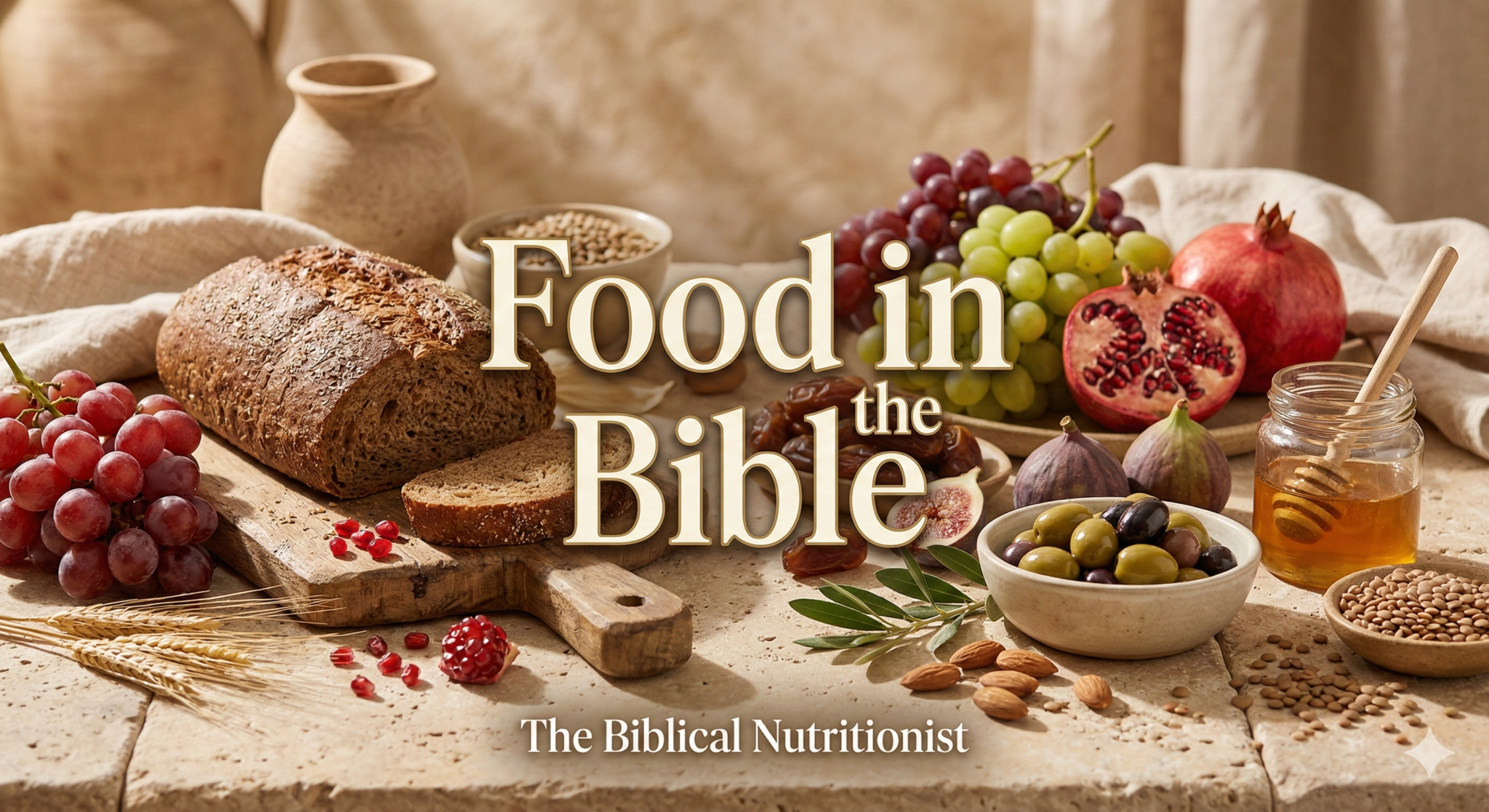
The diet in Biblical days has been proven through Scripture and also through archeology. Typical meals for a Jewish person to eat included grains and seeds, such as barley and legumes. Such legumes included fava beans, lentils, and chickpeas. Fruits were also consumed often in the Bible diet: figs, dates, pomegranates, and grapes. We read about how Jesus cursed a fig tree because it didn't do its job of bearing fruit.
Meat that was often consumed were goats, cows, and sheep, as well as fish. Because Jesus was Jewish, he followed biblical customs, such as not eating pork or shellfish, or other animals that were unclean.
Jesus's diet would be very similar to a modern Mediterranean diet. The Mediterranean Pyramid, which has one of the most solid and oldest foundations among all other food pyramids, focuses on whole and natural foods. In Dr. Steve Parker’s book, The Advanced Mediterranean Diet, he stated this diet is linked with overall better health and longevity, as well as a lower incidence of cancers and cardiovascular diseases. Combined with an active lifestyle, this diet supports longevity.
Therefore I believe in eating what is fresh, wholesome, and natural. When cooked or eaten raw, these foods nourish your cells, reduce inflammation, provide you with energy, and help you thrive by feeling your best!
Healing Food in the Bible: The Best Biblical Diet Foods
But ten men who were found among them said to Ishmael, "Do not put us to death; for we have stores of wheat, barley, oil, and honey hidden in the field." So he refrained and did not put them to death along with their companions. Jeremiah 41:8
What does the Bible say about healthy eating? It is beautiful to know that scripture is like a cookbook; one written by God and provided specifically for us. The list of food below is all mentioned in the Bible.
It is good for us to ask what Bible foods are best to eat, as the people around Jesus and even his disciples asked many questions to learn from him. This list includes the best foods in the Bible to eat.
The best options for us include fruits and vegetables from organic sources. You can find these at the farmer’s market, but make sure you pick out the best quality fruits that are free from GMO. I use a Produce Shopping Card and a GMO Card to guide me when buying fresh produce at the store or market. With most conventional farms spraying their crops with pesticides and other toxic elements, it is important to be vigilant and well-informed when it comes to buying non-GMO, all-organic products.
Vegetables
Genesis 25:34, Numbers 11:5, Numbers 13:23, Deuteronomy 23:24, Deuteronomy 28:40, 2 Samuel 16:1–2
Vegetables are a must-have in your diet. Our modern research tells us they should be one of our primary food groups, and the Bible agrees. A generous serving of vegetables each day provides the body with much-needed vitamins, minerals, fatty acids, fiber, and even protein.
In the Bible, lentils, beans, and onions are mentioned in verses such as Numbers 11:5 and 2 Samuel 17:27-29, where the Israelites remembered when their diet was rich. They specifically chose these items to feed their people.
Like God's people, every person should have a large helping of vegetables - a minimum of three one-cup servings daily. Choose cruciferous vegetables, either raw or steamed, for the most nutrients. These are vegetables with four petals, which resemble a cross or crucifix, hence the name: “Cruciferous”. They are one of the 12 Anti-Angiogenic foods, which help to Fight Against Cancer!
The secret behind their potency against various ailments lies in their phytochemicals. These phytochemicals repair the DNA in the cell, which transforms a mutated cell into a healthy cell. This reminds us of how Jesus’ death on the cross repairs and removes our sin!
Just as Jesus gives us eternal life, vegetables sustain us in our earthly life.
The Magnificent 12 Cruciferous Vegetables
These options have a high amount of protein, fiber, micro- and macronutrients, and should be your top picks when making your grocery list.
Broccoli
Brussels Sprouts
Cabbage
Cauliflower
Horseradish
Kale
Kohlrabi
Mustard Greens
Radish
Rutabaga
Turnip
Watercress
Find all the recipes you need for these nutrient-dense veggies in the Healthy Treasures Cookbook!
Proverbs 15:17 "Better a small serving of vegetables with love than a fattened calf with hatred."
God's Natural Sweetener: Fruit
Genesis 1:29, Numbers 13:23, Deuteronomy 8:8, Psalm 1:3, Proverbs 25:11, Revelation 22:2
Fruits are a must-have for a vibrant life. Modern research tells us these colorful treasures should be a primary part of our diet, and the Bible agrees. A generous helping of fruit each day provides the body with much-needed vitamins, minerals, complex carbohydrates, fiber, and powerful antioxidants.
In the Bible, fruits like grapes, figs, pomegranates, and dates are mentioned in verses such as Deuteronomy 8:8 and Numbers 13:23, representing God’s blessings and provision for His people. They were chosen to satisfy and nourish those who followed His design for health.
Like God’s people entering the Promised Land, every person should enjoy a variety of fruits—a minimum of two to four servings daily. Choose deep-colored fruits, like purple grapes or red pomegranates, for the most potent phytochemicals. These are “God-designed candies” that provide energy while helping to fight against inflammation and heart disease!
The secret behind their healing power lies in their ability to protect and even repair our cellular DNA. These nutrients act like a shield, defending our bodies from the ravages of toxins and disease. This reminds us of how God’s grace provides a covering for us and restores our spirit to wholeness!
Just as the Tree of Life in Revelation yields fruit for the healing of nations, fruits sustain us in our earthly life.
Nine Fruit to Add to Your Bible Diet Food List
These options are high in fiber and micronutrients and should be your top picks when making your grocery list.
- Grapes
- Figs
- Pomegranates
- Dates
- Apricots
- Melons
- Apples
- Berries
- Citrus
Psalm 1:3 “He will be like a tree firmly planted by streams of water, which yields its fruit in its season.”
Nuts: A Small but Mighty Bible Diet Staple
Genesis 43:11
Don't underestimate the size of this highly nutritious food in the Bible. They may be small, but they're definitely a powerhouse of nutrients! Nuts are rich in protein, fiber, essential fatty acids, and other vitamins and minerals.
Nuts help reduce the risk of heart disease, regulate cholesterol levels, prevent cancer, and lower blood pressure. For expectant mothers, athletes, and those trying for weight loss, nuts are a great snack.
In Genesis 43:11, Israel calls pistachio nuts and almonds some of the best products of their land. Almonds, walnuts, pecans, macadamia nuts, and Brazil nuts are some of the best snacks and ingredients we could have.
Ancient Grains in the Bible: Bread of Life
Genesis 41:56–42:2, Deuteronomy 8:8, Deuteronomy 32:14, Ruth 2, Ezekiel 4:9
Nothing beats the taste and quality of warm, freshly baked bread, and it takes an incredibly prominent role as food in the Bible. Bread reminds us of events such as Joseph saving the land during famine in Genesis, how Ruth met Boaz, when Jesus multiplied loaves to feed the hungry, and the breaking of the bread during the Last Supper. Jesus famously said, “I am the Bread of Life” (John 6:48).
In Bible verses about food, like Ezekiel 4:9, we see a specific blend of grains like barley and spelt. When we ask "what did Jesus eat," we find that whole, sprouted grains were a daily staple. Back during the time of Jesus, unleavened bread was the only bread people had, and it was very important to their diets and culture. Learn how to make unleavened bread from the Bible here!
For anyone pursuing healthy eating through a Biblical diet, switching from processed white flour to these ancient grains is a foundational first step. Your very own freshly milled whole grain flour is the best flour on a Bible diet. I use a mini mill that is handy and reliable for milling many nutritious and flavorful grains. You can use this mill to make oat flour, almond flour, and quinoa flour, which cater to dietary sensitivities and gluten intolerance.
Ready to start? Find the best places to buy organic, non-GMO grains online here.
By steering clear of white flour and milling your own ancient grains, you are choosing a healthier, cheaper, Biblical option for your bread and other dishes.
Food to Limit or Eat in Moderation
Anything in excess is not good. Certain foods in the Bible should be eaten in moderation to help your body receive nutrients and avoid negative effects linked with excessive consumption. The foods listed below should be eaten sparingly for the greatest health.
Salt: Healthy Eating with Flavor
Job 6:6, Matthew 5:13, Colossians 4:6
The Bible mentions salt over 40 times. In verses such as Matthew 5:13 and Colossians 4:6, salt is used as a symbol for our role as believers. Salt cannot be dissolved, which is important to the Biblical symbol of an everlasting covenant. Like God’s love for us, salt enhances the flavor of our lives and doesn't dissolve!
Besides its symbolic use, salt was heavily important for its role in flavoring food. It helps release the flavor of your vegetables, meats, fish, and fruits. As you cook food, the cells break down and salt helps with that process, releasing many wonderful flavors.
Salt is also vital for preservation; it gave all the people of Biblical times the ability to eat meat well after they prepared it.
Make sure you choose the right salt! I use this salt for all my cooking and food preparation needs, so I can partake in delicious meals knowing I am having what's best for my body with no unnecessary additives.
Raw Honey: God's Natural Sweetener
Numbers 14:7–8, Deuteronomy 32:13, Proverbs 24:13, Proverbs 25:16, 27, 1 Samuel 14:24–29
Food in the Bible often points to honey as a sign of God's abundance. It was very important and was a primary sweetener almost everywhere until the mid-1800s when sugarcane took over. Unlike modern refined sugars, honey fits perfectly into a biblical diet as a source of energy and healing enzymes.
We can see honey as God's blessings; when the Israelites found honey in the land God had chosen for them, they saw what He had for them was good. In 1 Samuel 14:24-29, honey gave Jonathan sweetness and joy during a hard time.
Though it shows how honey is good for us (Proverbs 24:13), the Bible warns us against eating too much in verses such as Proverbs 25:16 and 27.
There are different flavors and colors of honey: darker ones with more intense flavor and lighter ones with milder flavors. If you have diabetes, Tupelo and Sage honey are better for you, as these are broken down more slowly in your bloodstream.
In the Treasures of Health Nutrition Manual, there is great depth of teaching about honey. The teaching even includes how beneficial honey is during pregnancy.
Choose unpasteurized, pure, all-natural honey. Your body will receive more nutrients and benefits by choosing raw honey and eating it in small portions, while still getting the sweetness God designed for us.
Meat: The Best Protein in the Bible Diet
Genesis 9:3–4, Genesis 18:1–8, Leviticus 7:22–23, 26, Leviticus 7:28–36, Leviticus 11, Deuteronomy 14, Deuteronomy 32:14, 1 Kings 4:22–23, Acts 15:22–29, John 6:11
From Genesis throughout the rest of the Bible, God gives instructions about meat. There is a lot said about Bible dietary guidelines, but what exactly is clean and unclean food in the Bible, and what importance do these teachings have for us today?
First, we must understand what God said about meat. In the Garden of Eden, God provided a vegetarian diet - no meat was eaten. But after the flood, God commanded Noah, "Every moving thing that lives shall be food for you... But you shall not eat flesh with its life, that is, it's blood" (Genesis 9:3-4). Yet, Noah did not eat unclean animals since there were only one pair on the ark. If he ate the unclean, they would no longer exist.
To the Israelites, God gave important designations of what every person following His instructions should and should not eat. Clean animals are those that have cloven hooves and chew the cud. Unclean do only one or neither of these. Among water creatures, only those with fins and scales are clean. Here is a list of clean and unclean foods in the Bible.
Clean Animals in the Bible:
- Sheep
- Deer
- Goat
- Ox
- Antelope
- Fish (with fins and scales)
- Duck
- Turkey
- Quail
- Cornish Hens
- Chickens
- Locusts
- Grasshoppers
Unclean Animals in the Bible:
- Pigs
- Camels
- Rabbits
- Rock Badgers
- Shellfish
- Fish without fins
- Eagles
- Vultures
- Buzzards
- Falcons
- Ostriches
- And many more birds and insects
Through giving these instructions in Leviticus 11 about what is clean and unclean, God protected his people. Studies of bodies found in ancient tombs show that people in biblical times who ate unclean animals had more disease.
For instance, pigs eat anything from maggots to fecal matter. They carry about 200 diseases and 18 parasites that can be transferred to your body once you consume them. Shellfish and finless fish can also be unsafe to eat because of high levels of heavy metals such as mercury.
It's still good to observe these dietary guidelines given to us in the Bible. Our God provided us these instructions because He wants what is best for every person.
Milk Products: Rich Biblical Nourishment
Genesis 18:1–8, Numbers 14:7–8, Deuteronomy 32:14, Judges 4:19, Proverbs 27:27, Isaiah 55:1, Ezekiel 25:4, Joel 3:18, 1 Corinthians 4:7
Milk is the drink mentioned most often in the Bible. Often, milk and honey are in the Bible together, showing the richness and sweetness of lands (Exodus 3:8, 17 and Leviticus 20:24).
But why are milk and honey important in the Bible? Well, they're important both because of the nutritional value and as a symbol of abundance.
Raw cow's milk is considered a complete food. It has so many necessary components that you could almost live solely on drinking milk! It is packed full of beneficial enzymes, protein, vitamins, and minerals that are at higher levels in raw milk than in processed milk. Raw milk is also highly digestible and easily absorbed by your body.
If you are lactose intolerant but still want milk's nutrients, don’t fret! Unpasteurized yogurt is regarded as a good option for a person with lactose intolerance because of the live bacterial cultures. Yogurt can prevent colds, reduce bad cholesterol levels, improve bowel function, help fight breast and colon cancer, prevent allergic reactions, boost the immune system, and prevent intestinal infections.
Just an 8-ounce container of yogurt will give you 35-45% of your daily recommended calcium intake. You can eat yogurt on its own, add it to your muesli, use it as a topping on baked goodies, and so much more!
Whether you eat or drink your milk, raw options are perfect for following a Bible diet and partaking in the richness of this drink God has given us.
Annette on Social Media
Oil: Anointing Our Meals
Deuteronomy 8:8, Deuteronomy 32:13, 1 Kings 17:7–16, Proverbs 21:17, 20
Like milk and honey, oil is an important component in a rich land. It has an important role in the Bible, used for anointing and as a symbol of wealth.
But what is the best oil to use for cooking? The answer depends on how high the heat is. You should look for cooking oil with a high smoke point.
100% avocado oil is my favorite for frying on high heat or stir-frying because of its high smoke point. Same with coconut oil, which also contains good fats such as lauric acid and MCT oils. But if you don’t prefer the strong coconut flavor, avocado oil is great. Avocado oil contains oleic acid, which lowers bad cholesterol in your body and improves cardiovascular health. It also has lutein, an antioxidant that supports healthy vision.
Olive oil is better for your salads, dips, pesto, and hummus. This oil is sourced from one of the most versatile and highly valued trees in Biblical times: the olive tree. It was mentioned over 140 times in the Bible, and the olive was a sign of peace and God’s blessing.
Both olives and olive oil contain healing properties as they help slow and reverse cancer growth, stimulate bile flow, strengthen cell membranes, lower bad cholesterol, reduce gastric acidity, and supplement the body with vitamin E, an excellent antioxidant for healthy skin, hair, and overall health.
When buying and using oil, keep in mind these helpful tips:
Buy cold-pressed or unrefined oils
Avoid hardened oils
Don't get rancid-smelling oil
Never reuse oil
Store oil in a cool, dark place to maintain freshness
With the right oil, you can add these nutrients from the Biblical diet to your meals.
Eat the Bible Diet to Feel Your Best
Do you feel good after eating food? Or do you sometimes feel lethargic, heavy, and a little unbalanced or ungrounded afterward?
Your answers to these questions reveal your choice of food. What you eat affects not just your body but also your mind and emotions. But how can we know what to eat to feel good?
By understanding the food in the Bible and what God has gifted us to eat, you will reap incredible blessings that come with a healthy and balanced diet. And always remember, whatever you eat or drink, it's a blessing given to us for our health!
Use this course as a blueprint for a Biblical diet to help in planning daily meals and achieve outstanding health that leads to thriving and not just surviving!
Frequently Asked Questions About Food in the Bible
Is There Forbidden Food in the Bible?
God loved his chosen people. Therefore, he gave them a list of foods that were beneficial, and centuries later, we still see how the foods God called good and declared best for his chosen people still are the best foods for us today.
What Did Jesus Say About Food?
Throughout Scripture, food is used in many powerful ways—both practical and spiritual. It sustained daily life, but it also served as a teaching tool. Food illustrated obedience through dietary laws, symbolized holiness and separation, and reinforced trust in God’s provision, such as manna in the wilderness. The prophets and teachers often used food as object lessons and metaphors to communicate deeper truths.
Jesus continued this pattern in His ministry. He used food to reveal spiritual realities, calling Himself the “bread of life” (John 6:35), teaching that people do not live by bread alone but by every word of God, and using meals to demonstrate fellowship, forgiveness, and the coming kingdom of God. He multiplied loaves and fish to show compassion and divine provision, sent demons into pigs to illustrate spiritual authority and uncleanness, and used the Last Supper to establish a lasting covenant symbol through bread and wine.
In Scripture, food is never merely physical nourishment—it is a means of teaching faith, obedience, dependence on God, fellowship, holiness, and redemption.
What are the Seven Foods of the Promised Land?
The Seven Foods of the Promised Land are wheat, barley, grapes, figs, pomegranates, olives, and dates. These represent the Lord's provision and blessing for the Israelites, and they are good options to help follow a Biblical diet. They also teach a deeper spiritual meaning of how we can serve a loving God.
What is God's Purpose for Food?
Food is more than something to eat—it reflects God Himself as our Sustainer. He provides nourishment for our bodies through the provision He designed in creation, supplying what we need for strength, health, and faithful stewardship of our bodies as living temples set apart for Him.
Yet food also teaches. It reveals the rhythms of seedtime and harvest, planting and gathering, waiting and rejoicing. It illustrates dependence, gratitude, and trust in His timing and provision. Throughout Scripture, food becomes a lesson in spiritual hunger, obedience, blessing, and fellowship. Even its sweetness, like honey, reminds us that God’s gifts are not only sustaining but delightful.
Food, therefore, is never merely physical—it points beyond itself to the One who gives life and satisfies both body and soul.
What Bible Verses Says "Bless Your Food"?
In Matthew 14:19 and Mark 14:22, Jesus sets the example of thanking our heavenly Father for the food He has provided us. Before He fed five thousand people with fish and bread, He gave thanks for each morsel, and he did the same at the Last Supper. We should follow His example in thanking the Lord for the good and healthy food He has given us.
In addition, Deuteronomy 8:10 says, "When you have eaten and are full, then you shall bless the Lord your God for the good land which He has given you." This is so we can always remember the countless good things that have been done for us when partaking in each meal.
Full list of Bible Foods (Free Download)
Download your FREE copy of Food in the Bible!
You'll also be added to our free newsletter!